If you’ve ever stared at a cluttered room, drawer, or closet and wondered where on earth to start, you’re not alone. Even the most beautiful homes can fall apart if the organization isn’t in place. Over the years, I’ve tried every trick, bin, and labeling system under the sun, and this simple organizing method is the one that never fails me. It works in any room, any style, and any stage of life, from kid chaos to holiday overflow.
Whether you’re organizing a whole room or tackling one small drawer, this step-by-step system will help you create a space that feels functional, intentional, and actually maintainable.
The Five Steps of Organizing
Creating a beautifully organized home doesn’t have to feel overwhelming. No matter the size of the room or the amount of clutter you’re dealing with, this simple five-step method works every single time. It breaks the process down into manageable pieces so you can transform any space, from drawers to closets to playrooms, into something functional, streamlined, and easy to maintain.
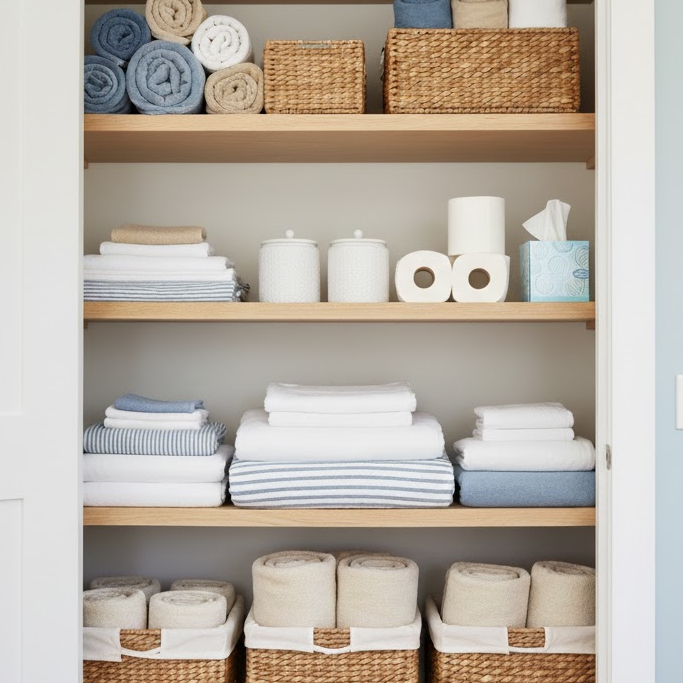
Below, I’ll walk you through each step as if we’re tackling a space together. Picture your linen closet in front of us, and here’s exactly how I’d approach it.
Step 1: What is the Purpose of the Space?
Before you touch a single item, get clear on how the space is supposed to function. If you’re working with a linen closet, decide what actually qualifies as “linens.” Is it just bedding? Do bath towels count? Do you have enough space for everything in this category, or do you have extra room and want the closet to serve multiple purposes, like storing cleaning supplies or even a vacuum?
When I’m defining the purpose of a space, I try to make it the one home for that category in my entire house. So if you currently have linens split between this closet, a guest room, and the basement, the goal is to bring them all together. If I’m looking for something, I want to know exactly where it is on the first try. That’s the whole idea behind “a place for everything and everything in its place.”
You also need to consider where the space is located and what’s nearby. If your linen closet is in a hallway by a guest bathroom with lots of storage for extra toiletries, move the bath products there. If it’s also near a guest bedroom you want to keep clean and uncluttered, maybe the linen closet becomes the perfect place for the tower fan or extra blankets that normally float around.
This step is all about paying attention to the pain points in both the space you’re organizing and the areas around it. How can you rearrange or rethink your home so every space works harder and feels more intentional? Once you define the purpose, decision-making becomes ten times easier. Everything that doesn’t belong becomes clutter.
Step 2: Empty the Entire Space
Yes, the entire thing. This is the step no one wants to do because it can get overwhelming fast. You start out motivated, pull everything out, and suddenly you’re surrounded by a mountain of stuff you didn’t even know you owned. Every tiny cabinet is hiding at least three surprises.
But this step is essential if you want a truly functional space. You need a clean slate. Once everything is out, wipe down the shelves, dust the corners, vacuum the floor, and if you’re doing a full reset, a fresh coat of paint can make any closet feel instantly more polished.
This is also the perfect moment to measure everything: shelf width, depth, height. I like to make a quick sketch with dimensions so that when it’s time to buy baskets or bins, I already know exactly what will fit. Nothing kills momentum like bringing home the perfect basket only to realize it’s half an inch too wide. (Keep a mini measuring tape in your purse for times like these!)
Emptying the space forces you to see what you’ve been holding onto, what you forgot existed, and what ended up here simply because no one knew where else to put it. You can’t build an organized system on top of old chaos, so starting fresh is the secret.
Step 3: Declutter with Intention
This is the make-or-break moment. Start by sorting everything into simple categories: keep, toss, donate, and relocate. If you have linens stored in multiple places, now is the time to gather every single one. The goal is to have your entire inventory of a category fit into one designated space. In this case, all linens should live in the linen closet, not scattered throughout the house.
When you’re decluttering, you have to be a little ruthless. If it doesn’t serve the space or support your everyday life, it shouldn’t stay. Most of us have enough room for the things we actually need, but we have far more stuff than we could ever use. And I can promise you this: a family of four does not need 20 bath towels. You also only need two sets of sheets per bed, not an entire linen store’s worth.
If you’re struggling to let things go, ask yourself a few honest questions: Would I buy this again today if I saw it in a store? Have I used or needed this in the last year? And here’s my favorite test: if there were poop on it (yes, really), would I bother cleaning it or would I throw it out? If the answer is no, then why are you keeping it?
For more ideas to help you declutter confidently, read my guide on overcoming the decluttering struggle.
Decluttering is essential for creating a home that feels calm instead of crowded. You don’t need to be a minimalist; that’s no fun. But you also don’t need to keep things just because they’re “still good” or because you spent money on them. If the item is taking up space and adding visual clutter, it isn’t serving you in any way.
Step 4: Create Zones (Even in Small Spaces)
Every organized space works because of one thing: zones. A zone is simply a designated spot for a specific category of items, and it keeps your space from slipping back into chaos. You might assume that a “linen closet” is a zone on its own, but it’s much more effective to break it into smaller, clearly defined areas so every item has an exact home.
Think about your shelves in terms of accessibility. The top shelf is best for items you rarely reach for, like seasonal bedding or overflow toilet paper. Middle shelves should hold the things you use regularly, such as bath towels or the sheet sets you rotate often. The lower shelves or floor space can store bulkier items like a basket for comforters, a cleaning caddy, or a vacuum if the closet is large enough.
Next, define the actual categories you want to store in this space. For a linen closet, this might include sheets, extra pillows, towels, first aid supplies, or cleaning products. Once you know what belongs here, you can assign each category its own zone. If something doesn’t fit comfortably within the zone you’ve chosen, that’s your cue to declutter further or get creative with storage solutions. (Vacuum bags are great for maximizing space in a small linen closet!)
Clear zones make it obvious where things belong, not just to you but to everyone in your home. Over time, the system becomes second nature, and even without labels, everyone remembers that the middle shelf is where the hand towels and tissue boxes live.
Step 5: Contain, Label, and Simplify
Once you’ve decluttered and defined your zones, it’s time to contain everything. The right bins, baskets, drawer inserts, or containers instantly make a space look more intentional and pulled together.
Start by considering which items visually clutter the space. In a linen closet, things like toiletries, first aid supplies, or cleaning products tend to look busy because of their labels. These are perfect candidates for opaque or woven baskets that hide the visual noise. Sheets are another example: they can easily turn into an unfolded mess, so use sheet bands or storage clips to keep them tight and tidy. Bulky items can go into large baskets, and anything stored up high should be placed in containers with easy-to-grab handles.
Aim for containers that share a cohesive look. That might be clean white bins, seagrass baskets, or even matching fabric bins. Personally, I don’t love clear acrylic for most spaces. Even though it looks pretty at first, it often makes a closet feel busy because you’re still seeing all the items inside. Choosing containers that hide clutter always gives the space a more polished, professional-organizing feel.
Finally, label everything. Label the baskets, label the bins, and even label shelves that might occasionally sit empty. An unlabeled spot is an open invitation for a child or husband to come along and put the wrong thing in the wrong place. It may feel like you’re “over-labeling,” but you aren’t. When you’ve put this much work into organizing a space, the goal is to make it foolproof for everyone who uses it. Labels keep your system intact so your hard work actually lasts.
Common Organizing Mistakes
- Organizing before decluttering – If you organize around the items you don’t use, your zones will never truly function. This is what creates that constant cycle of “I just organized this, why is it a mess again?”
- Buying bins too early – You can’t buy solutions before you know what you’re storing. Declutter first, finalize your categories, then choose containers with intention. It saves time, money, and a lot of frustration.
- Making categories too specific – Even though I personally love micro-organization, overly detailed systems rarely hold up. Your family should be able to maintain the space too, so keep categories simple and intuitive.
- Overfilling containers – The second a bin is stuffed, the system stops working. It becomes visually overwhelming and impossible to keep tidy. If something doesn’t fit, the container or the category needs adjusting, not more forcing.
- Expecting perfection without upkeep – Even the best system needs maintenance. Our homes change, our routines change, and the items we use change. That’s normal. The goal is consistency, not perfection.
How I keep Spaces Organized Long-Term
A beautifully organized space is only as good as the routine that maintains it. A few times a week, when I get a little burst of motivation, I do a quick sweep through a couple of areas. I toss whatever clutter snuck in, rehome items that belong elsewhere, and tidy the zones that need a reset.
The rule I love and live by is the “one in, one out” rule. When I buy something new and it’s going in a space that is already full, something old has to leave. If I buy a set of new towels, I don’t just stuff them into the closet wherever they fit. I take the time to determine what older towels can be taken out. Maybe they become towels for the dogs and get rehomed to the dog supplies in the laundry room. Or maybe I just donate them.
Staying organized isn’t about achieving a picture-perfect home. It’s about having systems that make tidying simple and sustainable.
What does this look like in other spaces?
So far I’ve stuck to the idea that we’re organizing a linen closet. But this method works for literally any space. Say we have a utensil drawer in the kitchen…
- Purpose: Everyday silverware and eating utensils.
- Empty: Take everything out and clean the drawer.
- Declutter: Toss items you never use or rehome things to another drawer.
- Zones: Maybe you have knives, chopsticks, or children’s utensils to create zones for.
- Contain: Add a drawer insert that fits the space well. Expandable organizers are great because they adjust to your drawer perfectly.
These five steps can serve as the framework for any organizing project, no matter how big or small.
Thank you for being here. If this post helped you, share it with a friend or save it to refer back to later. It really helps this space grow.
If you want to follow along for more home decor, organizing, seasonal ideas, and more lifestyle fun, check out my socials:
Instagram | Facebook |